


 910 481 086

Packaging EPR for food supplements in Spain: who the producer is and what the PPWR changes
In brief. Packaging EPR for food supplements affects whoever first places a packaged food supplement on the Spanish market. That company is a packaging producer. It must therefore join a collective system such as Ecoembes, register in the packaging section of the Product Producers Registry (RPP) at MITECO, which assigns the ENV number, and declare the kilos of packaging by material each year. If the company is not established in Spain, it also needs an authorised representative. None of these steps is complex in itself. The complex part is deciding correctly who is the producer, for which packaging, and in which countries.
We see it every week with brands that have been selling in Spain for years, with their product notified and their label reviewed. Many discover the obligation when Amazon asks for the ENV number or when a marketplace account is suspended. At that point, the problem is not getting registered: it is catching up on years of declarations that are overdue.
The legal framework: three rules, one obligation
In Spain, three pieces of legislation apply simultaneously:
| Legislation | What it covers |
|---|---|
| Law 7/2022 on waste and contaminated land | General EPR framework and penalty regime |
| Royal Decree 1055/2022 on packaging and packaging waste | Specific producer obligations, registry, collective systems, and declaration |
| Regulation (EU) 2025/40 (PPWR) | European packaging rules applicable from 12/08/2026, including the mandatory authorised representative for companies not established in the EU |
Who is the packaging producer for a food supplement brand
The definition in art. 16.1 of RD 1055/2022 points to the company that is the first to place packaged products on the Spanish market. That covers four scenarios that come up regularly in food supplements:
- Spanish brand, packaging done in Spain. The brand is the producer for all its formats.
- Spanish brand, packaging done outside Spain. Still the producer for what it sells in Spain, regardless of where it packages.
- Foreign brand without establishment in Spain, selling directly here. Also the producer. Needs an authorised representative. If it sells through a distributor established in Spain that is the first to place the product on the market, that distributor may be the producer.
- Sales through a marketplace or own online store. The one who prepares and ships the order is the producer for the shipping packaging. There are two exceptions in art. 17.5 of RD 1055/2022: if the packaging is provided by the courier service, or if the sale goes through a marketplace that covers EPR in the seller’s name, the seller is not the producer for that packaging.
Paying EPR in France does not change anything in Spain, because contributions do not travel from one country to another. What is paid there does not cover what is sold here.
The three cumulative obligations for food supplement producers
These are cumulative, and none replaces the others. The first two must be in place before placing packaging on the market.
- Joining a collective system (SCRAP). Ecoembes covers most lightweight packaging and paper and cardboard; Ecovidrio covers glass. Other systems exist for commercial and industrial packaging. A company-run individual system is also possible but almost never worthwhile in food supplements due to cost and complexity.
- Registration in the Product Producers Registry (RPP), packaging section, at MITECO. Registration requires submitting the certificate of adhesion to the collective system, per art. 15.2 of RD 1055/2022. The registry assigns the number in the format ENV/year/number, which is the one Amazon and other marketplaces require.
- Annual declaration. Covers the kilos placed on the market the previous year, by material and by type of packaging (domestic, commercial, industrial). Due before 28 February to the collective system and before 31 March to MITECO. For a detailed breakdown, see our article on annual packaging declaration deadlines and how to calculate the kilos.
Shipping packaging in online food supplement sales
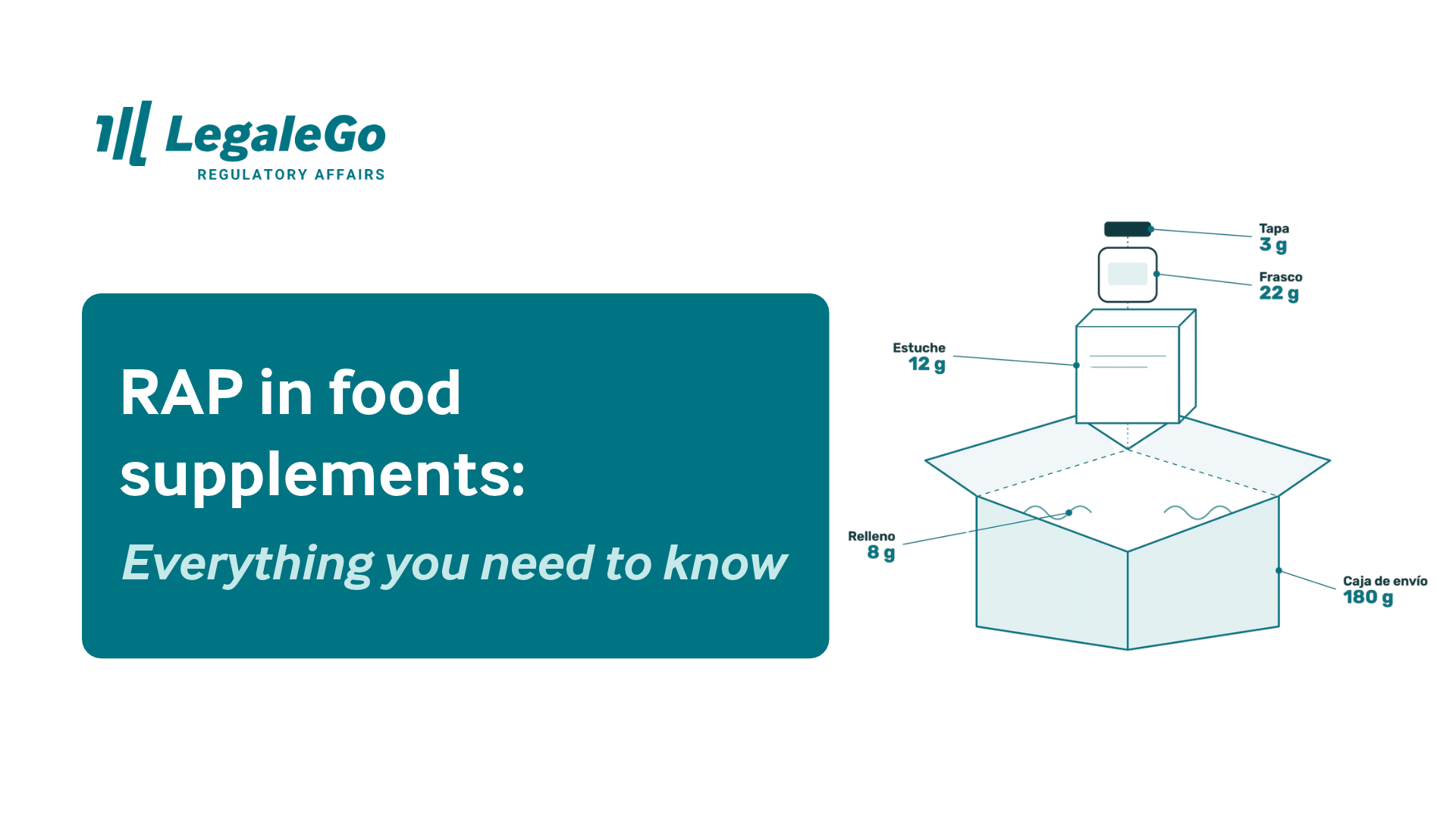
The cardboard box, the tape, the padding, and the shipping bag are also packaging. The company that prepares the order is the one placing them on the market, with two exceptions from art. 17.5 of RD 1055/2022. If the packaging is provided by the courier service, or if the sale goes through a marketplace, they cover EPR in the seller’s name.
In the online channel, this is the most common oversight: the company declares the bottle and the folding box but leaves out the shipping packaging.
There is also a sector-specific question. The measuring spoon, the desiccant, or the display unit delivered to the pharmacy may need to be classified as packaging. If so, they also need to be classified as domestic or commercial. That classification affects the contribution.
Foreign seller: the authorised representative
A company not established in Spain must designate an authorised representative by written mandate. In Spain, art. 17.2 of RD 1055/2022 already required this. Without a representative, the first distributor established in Spain is subsidiarily liable. The PPWR extends the same rule to the entire EU from 12 August 2026.
The representative handles joining the collective system, registration, and the annual declaration. They also act before the administration and before the SCRAP on the producer’s behalf. Before signing the mandate, however, it is worth understanding what the representative does not do:
- Does not replace the producer’s responsibility, which remains with the producer.
- Does not generate data: the representative needs the kilos by material and the packaging data sheets for each reference.
- Does not cover multiple countries: the mandate is national. The one for Spain does not cover France or Germany.
Packaging tariffs: how much EPR costs in food supplements
| Material | Domestic tariff (€/kg) | Commercial tariff (€/kg) |
|---|---|---|
| Rigid HDPE | 0.28-0.29 | 0.16-0.17 |
| Paper and cardboard | 0.12-0.13 | 0.04 |
| Steel | 0.20 | 0.13 |
| Aluminium | 0.04 | 0.13 |
Indicative tariffs, updated 30/09/2026. The applicable tariff is the one published by each SCRAP for the declaration year.
To put it in perspective: one tonne of domestic flexible film costs around €1,270 per year. One tonne of domestic cardboard is around €120. Packaging that reaches the consumer costs considerably more than commercial packaging. In food supplement EPR, correctly classifying each format, from the blister to the display unit, changes the bill.
What packaging EPR is not
In many conversations, three separate obligations are conflated:
| Obligation | Who | What is required | To whom |
|---|---|---|---|
| Packaging EPR | Producer (first to place on Spanish market) | Registry, SCRAP membership, annual kilos declaration | MITECO and SCRAP |
| Special tax on non-reusable plastic packaging | Manufacturer, importer, or intra-EU acquirer | Self-assessment per kilo of non-recycled plastic | Tax Agency |
| PPWR design requirements and Declaration of Conformity | Packaging manufacturer (whoever holds the brand or decides the design) | Packaging compliant with arts. 5-12 and its DoC | Market surveillance authority |
Complying with one does not exempt from the others.
Penalties and past years
Law 7/2022 classifies failing to register or declare as a serious infraction, with fines of €2,001 to €100,000. Collective systems may also charge a surcharge on the contributions for the years that were not declared. Both the system and MITECO can initiate proceedings.
Regularising past years voluntarily is always better. The conditions for voluntary regularisation are considerably more favourable than those applied when the administration initiates a review.
What the PPWR changes for food supplement packaging
The packaging obligation for food supplements is as multinational as product notification. Regulation (EU) 2025/40 (PPWR) adds a European layer on top of national systems without replacing them.
| Date | What is activated |
|---|---|
| 12/08/2026 | General application. Authorised representative mandatory for companies not established in the EU. Ban on PFAS in food contact packaging |
| 12/08/2028 | Recycled content label (if declared) and collection container labelling |
| 12/02/2029 | Label and QR code for reusable packaging |
| 2030 | Only recyclable packaging (classes A, B or C) and first minimums of recycled plastic, from 10 to 35% depending on format |
| 2038 | Only class A or B packaging |
| 2040 | Recycled plastic minimums from 25 to 65% |
The harmonised material label depends on an implementing act that has not yet been published. Packaging manufactured before each labelling deadline may continue to be placed on the market during a transitional period. No stock needs to be disposed of, but the next redesign must be planned now.
How we handle packaging EPR for food supplements
We do not start with forms. We start with decisions: who is the producer, in which countries, and with what data for each inspection or request. That is why we do not treat this as a routine registration: we do not just process, we decide.
Request a packaging diagnosis or download our free guide for brands. For any questions, write to us at info@legalego.com or call +34 910 481 086.
Frequently asked questions about packaging EPR for food supplements
What is the ENV number?
It is the registration number in the packaging section of the Product Producers Registry at MITECO. It has the format ENV/year/number and is the one marketplaces require.
If I have joined Ecoembes, am I already registered?
No. Joining the SCRAP and registering in the RPP are separate obligations. Both are required, along with the annual declaration.
I only sell food supplements to pharmacies. Does packaging EPR apply to me?
Yes. Since 1 January 2025, packaging EPR for food supplements also covers commercial packaging, not just packaging that reaches the end consumer. Pharmacies, restaurants, and offices are commercial channels.
What if I also sell in France, Italy, or Germany?
You need to register and declare in each country separately. Spain’s declaration does not cover other markets, and other markets’ payments do not cover Spain.
My brand is in Germany and sells directly to Spain. Who is the producer?
The company that first places the packaged product on the Spanish market. If it sells directly to Spanish customers or to Spanish distributors that do not repackage, the German company is the producer and needs an authorised representative in Spain.
References
Regulation (EU) 2025/40 of the European Parliament and of the Council (PPWR), art. 45 (authorised representative).
Law 7/2022 on waste and contaminated land, penalty regime.
Royal Decree 1055/2022 on packaging and packaging waste, arts. 15.2, 16.1, 17.2 and 17.5.
MITECO, Product Producers Registry: technical document and packaging FAQs.
Ecoembes, 2026 tariffs.
